

Museum
THE COLLECTIONS
The museum's collections consist of approximately 20,000 objects that illustrate the history of Suffolk County and Long Island. The majority of the collections are from the 19th century, but they also include Native American artifacts from prehistoric to modern time. We have an excellent collection of textiles and costumes, many fine examples of Long Island furniture and silver, as well as fine and decorative arts. The Society also collects everyday artifacts, ranging from agricultural equipment and craft tools to household goods. We limit our collecting to objects that relate to the history of Suffolk County, except when an item has wide appeal or great importance for our region. Our primary objective for collecting artifacts is to preserve and document the history of Suffolk County. The collections are open to researchers by appointment only. All requests must be sent in writing to the Director. The use of the collections is at the Society's discretion and will only be possible under staff supervision. Photography is prohibited throughout the building.
PERMANENT AND TEMPORARY EXHIBIT SPACES
Noel J. Gish Gallery
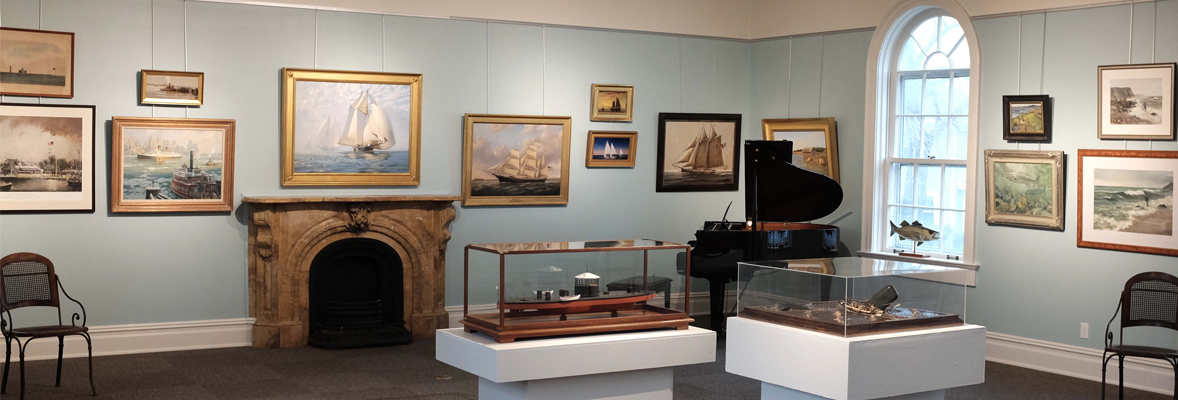
The Gish Gallery features a rotation of historically themed exhibits with a contemporary voice for our evolving audiences.
Sylvia Downs Staas Gallery
The Staas Gallery features long-running, large-scale historic exhibits with broad appeal. The large room enables us to exhibit a wide range of artifacts that document and illustrate the rich history of Suffolk County.
So Ends This Long Journey
Whaling was one of the most important industries in Suffolk County in the 19th century, although its roots go back to the Native Americans. This permanent exhibit space examines whaling on Long Island and includes recent research on the roles of Native Americans and African Americans.
Early Suffolk Transport
In this permanent exhibit, visitors will find wagons, carriages, sleds, bicycles, tools, a Riverhead Mile Marker, and much more. The tools and trades of the blacksmith and wheelwright were necessary in early communities that depended on horse and wagon for transport. A 1905 Oldsmobile owned by John Van Mater Howell of Southold - the first automobile on the East End - is the centerpiece of this exhibit that explores the many ways that Suffolk County residents have traveled the island.
Robert David Lion Gardiner Gallery
The Gardiner Gallery focuses on local community history topics, in the spirit of Robert David Lion Gardiner's passion for Suffolk County's past. Photographs and a historic film take visitors on a tour of Gardiner's Island and tell the story of the Gardiner family's heritage. Other mini-exhibits in this space explore the history of the Peconic River in Riverhead, of the Suffolk County Historical Society, and more.
Weathervane Gallery
The Weathervane Gallery features changing exhibits by local artists, photographers, and historical organizations. It is also home to our Weathervane Book Shop.
Arms and Armament
Although home to few major battles, Long Island and Suffolk County men and women have participated eagerly in support of our country. Our military exhibit includes examples of 18th-century flintlocks, a variety of guns from the 19th century, and Civil War weapons and memorabilia.